
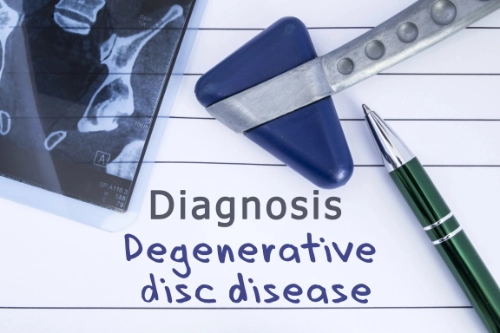
 If you’ve been told you have degenerative disc disease, the word “disease” alone can be enough to send you into a spiral of worry. Here’s the first thing worth knowing: despite the name, degenerative disc disease (DDD) isn’t actually a disease at all. It’s a natural, age-related change in the discs that cushion your spine, and for many people it causes little to no pain. When it does cause pain — stiffness, aching, or nerve-related symptoms that radiate into the arms or legs — chiropractic care offers a conservative, non-invasive way to manage symptoms, improve spinal function, and help you avoid the more aggressive route of injections or surgery. Let’s break down what’s actually happening in your spine, why it happens, and what a chiropractor can realistically do about it.
What Is Degenerative Disc Disease?
Your spine is made up of 24 movable vertebrae, and between each one sits an intervertebral disc — a shock-absorbing cushion with a tough outer ring (the annulus fibrosus) and a gel-like center (the nucleus pulposus). These discs allow your spine to bend, twist, and absorb impact throughout the day.
Degenerative disc disease refers to the gradual wear-and-tear changes these discs undergo over time. As you age, discs naturally lose water content and elasticity, becoming thinner and less able to cushion the vertebrae above and below them. This can lead to reduced disc height, small tears in the outer annulus, and increased stress on the surrounding facet joints, ligaments, and muscles.
DDD most commonly develops in two areas: the cervical spine (neck) and the lumbar spine (lower back), simply because these regions carry the most movement and mechanical load. It’s important to understand that disc degeneration is found on imaging in a huge percentage of adults — including many with zero symptoms. The presence of degenerative changes on an MRI doesn’t automatically mean you’re destined for chronic pain; it’s when those changes start to irritate nearby nerves or destabilize spinal mechanics that symptoms show up.
What Causes Degenerative Disc Disease?
Several factors contribute to disc degeneration, and most people experience a combination of them:
- Age: Disc hydration and structural integrity naturally decline over the decades — this is the single biggest driver of DDD.
- Repetitive mechanical stress: Jobs or activities involving heavy lifting, prolonged sitting, or repetitive bending and twisting accelerate wear on the discs.
- Poor posture: Forward head posture and slouched sitting increase compressive load on specific disc levels, speeding up degeneration in those segments.
- Previous injury: A prior disc herniation, whiplash injury, or spinal trauma can leave a disc more vulnerable to accelerated degeneration.
- Genetics: Family history plays a meaningful role in how quickly and severely someone’s discs degenerate.
- Smoking: Nicotine reduces blood flow to spinal discs, which are already poorly vascularized, further limiting their ability to stay hydrated and repair themselves.
- Excess body weight: Added load through the lumbar spine increases compressive stress on lower back discs over time.
- Sedentary lifestyle: Discs rely on movement to pull in nutrients and fluid; a lack of regular motion can speed up degeneration rather than protect against it.
Common Symptoms of Degenerative Disc Disease
Symptoms vary widely depending on which spinal level is affected and whether a nearby nerve root is being irritated. In the lumbar spine, people often describe:
- Low back pain that worsens with sitting, bending, or lifting
- Pain that improves with walking or changing positions frequently
- Stiffness, especially first thing in the morning
- Periodic flare-ups of sharp pain followed by weeks or months of dull aching
- Radiating pain, numbness, or tingling into the buttocks or legs (sciatica-type symptoms) if a nerve root is irritated
In the cervical spine, DDD tends to present as:
- Neck stiffness and reduced range of motion
- Aching that spreads into the shoulders or upper back
- Headaches originating from the base of the skull
- Numbness, tingling, or weakness radiating down an arm if a cervical nerve root becomes involved
One hallmark of DDD is that symptoms often ebb and flow rather than progressing in a straight line. You might have a rough week or month, followed by a stretch of feeling relatively fine, even though the underlying disc changes haven’t reversed. This pattern is actually good news from a treatment standpoint — it means the pain is heavily influenced by mechanics, inflammation, and muscular support, all of which respond well to conservative care.
How Chiropractic Care Treats Degenerative Disc Disease
Chiropractors can’t reverse disc degeneration itself, but that’s not really the goal. The goal is to reduce the mechanical stress driving your symptoms, restore movement in the segments above and below the affected disc, calm inflammation, and build the surrounding support system so your spine can function comfortably despite the degenerative changes. A typical care plan includes:
Spinal Manipulation and Mobilization
Gentle, targeted adjustments to the vertebrae surrounding a degenerated disc help restore normal joint motion, reduce compensatory stiffness in nearby segments, and take pressure off irritated facet joints and nerve roots. For patients with more advanced degeneration, chiropractors often use lower-force mobilization techniques or instrument-assisted adjustments rather than high-velocity manipulation.
Flexion-Distraction Technique
This specialized technique uses a gentle, rhythmic pumping motion on a specialized table to decompress the spine, increase space between vertebrae, and reduce pressure on affected discs and nerve roots. It’s one of the most well-studied chiropractic approaches specifically for disc-related lumbar pain and is often a cornerstone of DDD treatment plans.
Spinal Decompression Therapy
Non-surgical spinal decompression uses controlled traction to gently stretch the spine, creating negative pressure within the disc that can encourage fluid and nutrients back into the disc space, reduce nerve root irritation, and relieve pressure-related pain.
Soft Tissue Therapy
Myofascial release, trigger point therapy, and instrument-assisted soft tissue mobilization (IASTM) address the tight, overworked muscles that develop around a degenerating disc as your body tries to stabilize the area. Releasing this tension often provides meaningful relief on its own.
Core and Spinal Stabilization Exercises
Because the deep stabilizing muscles of the spine play a major role in protecting discs from excess load, chiropractors prescribe targeted strengthening exercises for the core, multifidus, and paraspinal muscles. A stronger stabilization system reduces the day-to-day mechanical stress on the affected disc.
Postural Correction and Ergonomic Guidance
Since posture directly influences disc loading, chiropractors evaluate how you sit, stand, sleep, and move throughout your day, then provide practical corrections — workstation setup, sleeping position, lifting mechanics — to reduce ongoing stress on the degenerated segment.
Chiropractic Care vs. Injections and Surgery
For most cases of degenerative disc disease, conservative care is the appropriate first step — and the evidence backs this up. Epidural steroid injections can offer short-term relief from inflammation but don’t address the underlying mechanical dysfunction and often need to be repeated. Surgical options like spinal fusion or disc replacement carry real risks, extended recovery times, and are generally reserved for cases involving significant instability, progressive neurological deficits, or symptoms that haven’t responded to months of conservative treatment.
Chiropractic care addresses the mechanical drivers of DDD-related pain directly, without the risks, recovery time, or cost associated with invasive procedures. Many patients find that a structured chiropractic care plan meaningfully reduces pain and improves function without ever needing to consider injections or surgery — and even patients who eventually do need more advanced intervention often benefit from chiropractic care as part of a broader, multidisciplinary approach.
What to Expect During Recovery
Because degenerative disc disease is a chronic condition rather than an acute injury, treatment goals look a little different than they would for something like a sprain. Rather than a fixed “recovery timeline,” most patients follow a pattern like this:
The first two to four weeks of care typically focus on reducing acute pain and inflammation through more frequent visits combining adjustments, decompression, and soft tissue work. From there, care shifts toward rebuilding strength and stability, with visit frequency gradually decreasing as your spine responds. Many patients transition to a maintenance schedule — periodic visits aimed at keeping the spine moving well and catching flare-ups early before they become disabling.
It’s realistic to expect good days and harder days even once you’re feeling significantly better; that’s the nature of a degenerative condition. The goal of ongoing chiropractic care isn’t to “cure” DDD but to keep your spine functioning as well as possible, minimize flare-up frequency and intensity, and help you stay active without relying on medication.
Take the Next Step Toward a Healthier Spine
Living with degenerative disc disease doesn’t mean you have to accept ongoing pain as your new normal. If you’re dealing with chronic back or neck stiffness, recurring flare-ups, or nerve-related symptoms, our team can perform a thorough evaluation, identify exactly which spinal segments are involved, and build a personalized care plan to help you move and feel better. Call our office today to schedule your consultation and take the first step toward long-term relief.
Frequently Asked Questions
Is degenerative disc disease the same as a herniated disc?
No. Degenerative disc disease refers to the gradual, age-related wear and loss of hydration in a disc over time, while a herniated disc is a specific injury where the inner gel-like material pushes through a tear in the disc’s outer wall. That said, degenerated discs are more prone to herniation, so the two conditions are often related.
Can degenerative disc disease be reversed?
The structural changes involved in disc degeneration aren’t reversible, but that doesn’t mean you’re stuck with pain. Chiropractic care, targeted exercise, and lifestyle changes can significantly reduce symptoms and improve spinal function even though the disc itself has degenerated.
At what age does degenerative disc disease typically start?
Disc degeneration can begin as early as your 20s and 30s, though it becomes far more common — and more likely to produce symptoms — starting in your 40s and 50s. Genetics, activity level, and prior injuries all influence when and how significantly it develops.
Is it safe to get chiropractic adjustments with degenerative disc disease?
Yes, for the vast majority of patients. Chiropractors adjust their technique based on the severity of degeneration, often using gentler mobilization or low-force adjusting methods when appropriate. A thorough evaluation, including a review of any imaging you have, ensures your treatment plan is safe and appropriate for your specific spine.
What activities should I avoid with degenerative disc disease?
Prolonged static positions — whether sitting or standing — tend to aggravate symptoms, as does heavy lifting with poor form and high-impact activities that jar the spine. Most patients do best staying active with low-impact movement like walking, swimming, or guided exercise rather than avoiding activity altogether.
Will degenerative disc disease eventually require surgery?
Most cases never reach that point. Surgery is generally only considered when there’s significant spinal instability, progressive nerve damage, or debilitating symptoms that haven’t improved after an extended course of conservative care. The large majority of DDD patients manage their symptoms successfully with chiropractic care, exercise, and lifestyle adjustments.
How long does it take to feel relief from chiropractic care for degenerative disc disease?
Many patients notice some improvement in pain and mobility within the first two to four weeks of consistent care, though full results depend on the severity of degeneration, how long symptoms have been present, and adherence to home exercises. Because DDD is a chronic condition, ongoing maintenance care is often part of a long-term management plan.

